
leave a message
If you are interested in our products and want to know more details,please leave a message here,we will reply you as soon as we can.


Westpoint Pharmaceutical’s DESU® Microcrystalline Cellulose (MCC) is categorized into three main series. Below is a breakdown of each grade and its optimal application scenarios for oral solid dosage formulations:
All DESU® MCC grades are produced via WestPoint Pharmaceutical’s proprietary spray-drying technology. This process allows for precise control over microstructure and physicochemical properties, ensuring performance parity with leading international brands. It provides a reliable raw material solution for the industrial-scale manufacturing of oral solid dosage forms.
WestPoint Pharmaceutical's DESU® MCC PH-101 features a fine particle size (D50 approx. 50μm), high specific surface area, and a water absorption rate of up to 310%. It is a core excipient designed to handle challenging tableting demands, offering excellent compatibility with Wet Granulation, Dry Granulation, and Direct Compression processes.
Performance Across Formulation Processes:
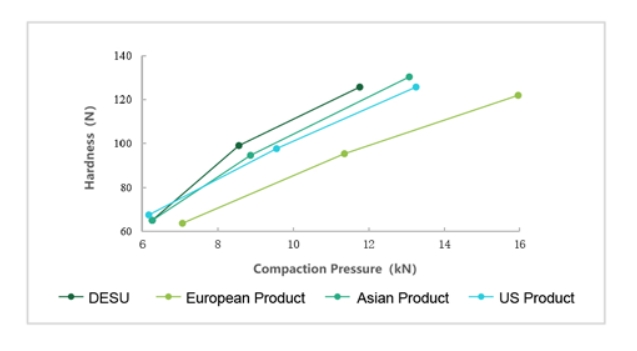
The fine particle size of DESU® MCC PH-101 allows it to form a more uniform granular structure when mixed with hydrophilic binders. It demonstrates outstanding compressibility. In the wet granulation of Atorvastatin Calcium Tablets, DESU® MCC PH-101 achieves a tablet hardness of 130N at a main compression force of only 12kN. As shown in Figure 1, its overall compactability surpasses that of comparable products from Asia, the US, and Europe. Furthermore, it offers superior disintegration performance, disintegrating in just ~2 minutes even at a hardness of 130N—significantly faster than the ~3 minutes required by European alternatives.
Figure 1 Compressibility Curve of Different PH-101 in Atorvastatin Calcium Tablets
In applications like Apixaban Tablets utilizing dry granulation, the blend containing DESU® MCC PH-101 exhibits an Angle of Repose of only 38.1°. This is lower than competing products from Europe (40.6°) and the US (40.9°), indicating superior flow properties while maintaining excellent compressibility (see Table 1). The disintegration time curve remains smooth and linear relative to increasing hardness, ensuring stable disintegration even under high-hardness conditions. This provides a wide and forgiving Formulation Design Space.
Table 1 Comparison of Micromeritic Properties of PH-101 Total Mixed Powder from Different Sources
| Final Blend Powder | Angel of Repose | Hausner Ratio |
| DESU | 38.1° | 1.32 |
| European Product | 40.6° | 1.31 |
| Asian Product | 37.9° | 1.33 |
| US Product | 40.9° | 1.33 |
DESU® MCC PH-101 exhibits significantly better compressibility at low pressures compared to PH-102 grades. At a main compression force of just 2kN, it achieves a hardness of 58N (compared to 48N for PH-102). This makes it ideal for formulations with a high API load or moisture-sensitive/brittle Active Pharmaceutical Ingredients (APIs) requiring low-pressure protection. In the direct compression of Levofloxacin Tablets, the tablet friability was only 0.10%, outperforming German (0.16%) and American (0.15%) competitors. Additionally, it ensures a more uniform dissolution profile with a smaller intra-batch RSD.
DESU® MCC PH-101 is manufactured using WestPoint Pharmaceutical's proprietary Spray-Drying Technology. This process allows for the precise control of microstructure and physicochemical properties, ensuring excellent batch-to-batch consistency. It serves as a reliable alternative to international brands, providing robust support for the development and large-scale manufacturing of Oral Solid Dosage (OSD) forms.

 English
 français
 русский
 español
 العربية
 Indonesia